
How to Write a Japanese Resume (履歴書, Rirekisho): Guide for Foreigners
Last updated: October 2026
Applying for a job in Japan usually means preparing two documents, not one. The first is the 履歴書 (rirekisho, a standard resume form). The second is the 職務経歴書 (shokumukeirekisho, a detailed work history). This guide explains what each one is, how to fill in the rirekisho field by field, and the mistakes foreigners make most often.
Quick answer
- A Japanese resume is a fixed-format form (履歴書) plus a free-format career history (職務経歴書).
- Put a recent 4 cm × 3 cm photo on the rirekisho, taken within the last three months.
- Write your name in katakana in the furigana field, and list education and jobs oldest to newest.
- End the history with 現在に至る and 以上.
- Typed resumes are now widely accepted. Use polite Japanese and keep every date format consistent.
Rirekisho vs shokumukeirekisho vs a Western resume
A Western resume mixes everything in one free-form document. Japan splits the job in two: one form for facts, one document for the story.
| 履歴書 (rirekisho) | 職務経歴書 (shokumukeirekisho) | Western resume / CV | |
|---|---|---|---|
| Purpose | Basic profile and dated history | Detailed work experience and achievements | Both, in one document |
| Format | Fixed form with set boxes | Free format, usually 1 to 3 pages | Free format |
| Photo | Yes | No | Usually no |
| Contains | Name, birth date, address, education, jobs, licenses, motivation | Employers, roles, projects, results, skills, self-PR | Summary, experience, skills, education |
| Used for | All applications; HR records | Mid-career and experienced hires | Applications outside Japan |
For a deeper look at the second document, read our shokumukeirekisho guide.
Do you need a Japanese resume or is English enough?
It depends on who you are applying to. Companies that hire internationally, such as multinationals and many tech companies, often accept an English resume. TokyoDev notes that companies advertising there generally expect English, while firms with a mostly Japanese workforce may want something different.
A Japanese rirekisho is usually needed when:
- The job posting is written in Japanese.
- The company is a traditional Japanese company or a mid-sized firm with few foreign staff.
- The posting or recruiter asks for 履歴書 and 職務経歴書 by name.
- You apply through a Japanese recruitment agency that submits documents on your behalf.
When in doubt, ask the recruiter. Some applicants send both an English resume and a Japanese rirekisho. If you only have an English resume today, see how to convert an English resume to Japanese.
Write in English. Get a Japanese resume PDF.
Rireksho turns your English details into a 履歴書 and 職務経歴書 in Japanese. Free: a Japanese 履歴書 PDF (3 downloads a day), no Japanese needed. The Complete Application Pack (¥980) adds the 職務経歴書, AI-written 志望動機 and 自己PR, and editable Excel and Word files.
Create my 履歴書 freeThe rirekisho, section by section
The sample below uses the widely used JIS-style 履歴書 layout. The Ministry of Health, Labour and Welfare (MHLW) published a recommended format in April 2021. Both are recommendations, not laws, so individual companies may still use their own forms.
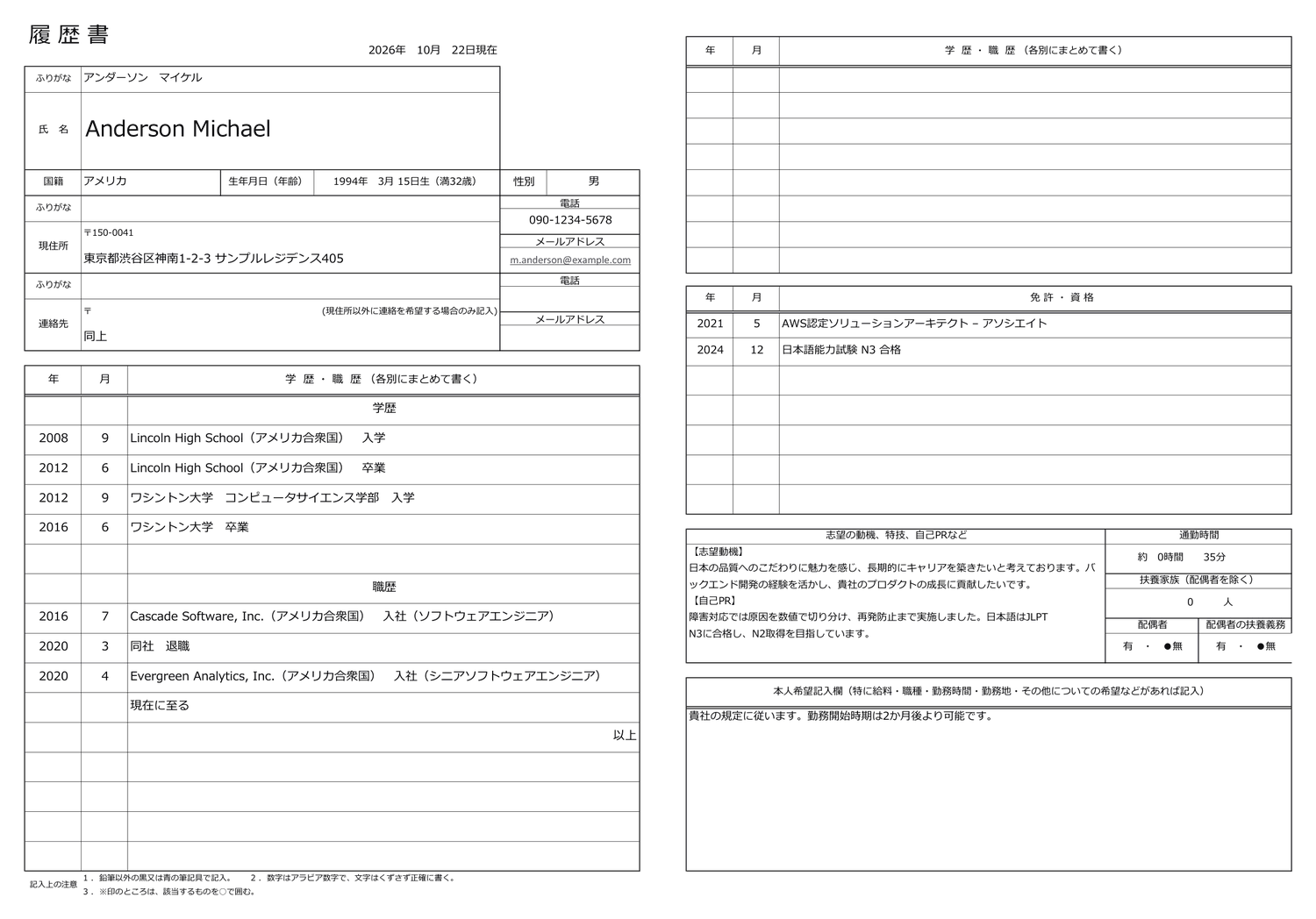
1. Date of submission (日付)
Write the day you send or hand in the resume, not the day you started filling it in. For a mailed application, match the postmark date. Use the same year style (Western or era) as the rest of the form.
2. Name and furigana (氏名・ふりがな)
Write your name in your usual spelling, and the pronunciation in the furigana box above it. For foreign names, use katakana, family name first: スミス マイケル. The form heading may say ふりがな (hiragana) or フリガナ (katakana). Follow the form, and use katakana if it does not say. If you have a 在留カード (residence card), keep your spelling consistent with it.
3. Date of birth and age (生年月日・満年齢)
Write year, month and day in that order. Use Western years (1990) or Japanese era years (令和, 平成, 昭和), but pick one style and keep it throughout. Age is the full age (満) on the date of submission. Era years are Reiwa from May 2019, Heisei 1989 to 2019 and Showa 1926 to 1989.
4. Gender (性別)
The 2021 MHLW format made this field optional and no longer forces a male/female choice. You may leave it blank. Some older company forms still ask, so fill it in only if the form requires it.
5. Photo (証明写真)
- Size is usually 4 cm tall × 3 cm wide.
- Taken within the last three months, against a plain background.
- Business clothes, tidy hair, and a natural, slight smile. Wear glasses if you normally do.
- Write your name on the back, then glue the photo in the box. Do not use tape on the edges.
- Photo booths near stations print this size, typically for a few hundred yen.
If you send a digital file, paste a high-resolution photo into the box at the printed size.
6. Address and contact (現住所・連絡先)
- Start with the postal code, then the prefecture, and write the address in full with no abbreviations.
- Include the building and room number, and add the furigana for the address.
- A mobile number and a regular email address are enough. Avoid a joke or old email address.
- The separate 連絡先 box is only for an alternative contact. Leave it blank if it is the same as your address. Do not write your current employer there.
7. Education and work history (学歴・職歴)
These share one chronological block, oldest first. Write the heading 学歴 in the centre of the line, list your schools, then write 職歴 in the centre and list your jobs.
- Education: start from high school (or your last two schools), with entry and graduation on separate lines: 入学 (entered) and 卒業 (graduated).
- Work: write the full company name, then 入社 (joined) on one line and 退社 or 退職 (left) on another. Add a short line about the department or role if space allows.
- List full-time jobs. Put the detail on the shokumukeirekisho rather than repeating it here.
- Explain gaps briefly. Unexplained gaps worry employers.
- If you are still employed, finish with 現在に至る (up to the present). On the next line, aligned to the right, write 以上 (that is all).
Example of the pattern:
学歴
2012年 9月 Example University 入学
2016年 5月 Example University 卒業
職歴
2016年 7月 Example Corp. 入社
2024年 3月 一身上の都合により退社
2024年 4月 Sample Inc. 入社
現在に至る
以上
一身上の都合により退社 means “left for personal reasons”. It is the standard polite wording when you resigned of your own choice.
8. Licenses and qualifications (免許・資格)
List in date order. Licenses use 取得 (obtained) and exams use 合格 (passed).
- 日本語能力試験N2 合格 (JLPT N2 passed). Include your level if you took it.
- 普通自動車第一種運転免許 取得 (standard driver’s licence). Include it even if you do not drive.
- Other language tests (TOEIC, IELTS) and professional certificates relevant to the job.
If you have none, write なし (none).
9. Motivation (志望動機)
This explains why you want this company and role. Be specific about the company, tie it to your own experience, and write in polite です・ます sentences. A generic paragraph copied between companies is easy to spot. Two to four short paragraphs fit the box. For examples and wording, see our guide to 自己PR and 志望動機.
10. Self-promotion (自己PR)
Your strengths, backed by one or two concrete examples. Keep it relevant to the job and avoid filler. Some forms combine this with the motivation box.
11. Requests (本人希望記入欄)
You can leave this blank and discuss conditions at the interview. The common safe line is 貴社の規定に従います (I will follow the company’s regulations). Use it for specific points only if they matter, such as interview availability or the need for visa sponsorship.
12. Fields that were removed or are optional
The 2021 MHLW format dropped commute time (通勤時間), spouse (配偶者), number of dependents (扶養家族数) and spousal support obligation. Gender is optional. The widely used JIS-style layout, including the Rireksho sample above, still has these boxes, as do older company forms. You can leave them blank or fill them in as appropriate. If a box is on the form, fill it in or write なし, and never leave a printed box looking forgotten.
Where to put your visa status
The standard format has no dedicated residence-status field, so conventions vary. Many foreign applicants living in Japan add their nationality and 在留資格 (status of residence), for example 技術・人文知識・国際業務, near the top of the form or in the requests box. If you need sponsorship, say so in one short line. When a company form has its own field, use it. If you are unsure, ask the recruiter.
Common mistakes foreigners make
- Sending only an English resume to a traditional Japanese company.
- Using a casual selfie or holiday photo instead of a business ID photo.
- Mixing Western and era years, or switching date formats halfway.
- Leaving the furigana blank, or writing it in the wrong script.
- Abbreviating the address or leaving out the building name.
- Forgetting 現在に至る and 以上 at the end of the history.
- Leaving unexplained gaps in the work history.
- Writing the motivation in casual Japanese, or using the same text for every company.
- Repeating all the shokumukeirekisho detail on the rirekisho.
- Submitting machine-translated Japanese without a native speaker checking it.
Handwritten or typed? PDF or paper?
Handwriting used to be close to required. Today most employers accept a typed resume, and typed files are easier to correct and reuse. A few traditional employers still prefer handwriting, and some say so in the posting. If the posting asks for a handwritten resume, write it by hand with a black pen. If you make a mistake, start again on a fresh sheet.
- Email: send a PDF unless the company asks for Word or Excel. Use a clear file name such as 履歴書_Surname_Given.pdf.
- Post: use a large envelope and do not fold the documents. Put them in a clear folder in the order the posting lists them.
- Copies: do not photocopy a signed paper resume for another company. Print a fresh one each time.
Want to see what a finished one looks like? See our Japanese resume example, or the Japanese resume template guide.
Final checklist before you send it
- Photo is recent, correct size and firmly attached.
- Name, furigana and date of birth match your ID.
- All dates use one style, and the history runs oldest to newest.
- The history ends with 現在に至る and 以上.
- Motivation names the company and the role.
- A native speaker has read the Japanese.
- The shokumukeirekisho is ready and consistent with the rirekisho.
Write in English. Get a Japanese resume PDF.
Rireksho turns your English details into a 履歴書 and 職務経歴書 in Japanese. Free: a Japanese 履歴書 PDF (3 downloads a day), no Japanese needed. The Complete Application Pack (¥980) adds the 職務経歴書, AI-written 志望動機 and 自己PR, and editable Excel and Word files.
Create my 履歴書 freeFrequently asked questions
Do I need a rirekisho or is an English resume enough?
It depends on the employer. International companies and many tech companies in Japan accept an English resume. Traditional Japanese companies, and many mid-sized firms hiring in Japanese, usually expect a Japanese rirekisho and shokumukeirekisho. If the job posting is in Japanese, prepare both documents. If it is unclear, ask the recruiter.
Is a Japanese resume handwritten?
Not usually any more. Handwriting was once close to mandatory, but most employers now accept a typed resume sent as PDF, Word or Excel. A few traditional employers still prefer handwriting. Check the job posting, and if it asks for a 手書き (handwritten) resume, follow it.
What photo size does a rirekisho need?
The usual size is 4 cm tall by 3 cm wide. Use a recent photo, taken within the last three months, with a plain background and business clothes. Photo booths near stations can print this size. Some forms print the exact size in the photo box, so match that if it differs.
Should I use Western or Japanese era dates?
Either is accepted, but you must be consistent. Many guides say foreign companies and IT employers are fine with Western years (2026), while traditional companies often prefer era years (令和8年). If you are applying from abroad and unsure, Western years are the safer choice because they are unambiguous.
How long should a Japanese resume be?
The rirekisho is a standard form of about two pages (A4 or B5 on paper, sometimes A3 folded). The shokumukeirekisho is usually one to three pages. Do not squeeze the rirekisho into one crowded page, and do not pad the shokumukeirekisho.
How do I write a foreign name in katakana?
Write the pronunciation of your name in katakana in the furigana field, with the family name first, then the given name. For example, Michael Smith becomes スミス マイケル. Katakana is the safe choice for foreign names, although some forms allow hiragana. Spell it the way you actually pronounce it, and match the katakana on your 在留カード (residence card) if you have one.
What is the difference between a rirekisho and a shokumukeirekisho?
The rirekisho is a fixed-format form with your basic profile, education, work history dates and qualifications. The shokumukeirekisho is a free-format document that explains your responsibilities, projects and achievements in detail. It is the closer equivalent of a Western resume. Most employers expect both for mid-career hiring.
Where can I get a blank template?
The Ministry of Health, Labour and Welfare (厚生労働省) publishes a recommended 履歴書 format through Hello Work, and stationery and convenience stores sell paper pads. Our rirekisho template guide explains the layout and each field. Rireksho does not offer a blank file; it generates a filled-in one from English input.
Do I need to write my visa status on a Japanese resume?
The official MHLW format has no dedicated residence-status field, so there is no single rule. Many foreign applicants who live in Japan add their nationality and 在留資格 (status of residence) near the top or in the 本人希望記入欄 request field, because employers need to confirm that you can work. If you need visa sponsorship, say so briefly there. Ask the recruiter if you are unsure.