
Japanese Resume Examples (履歴書 / Rirekisho Samples)
Last updated: October 2026
Seeing a finished 履歴書 is the fastest way to understand what Japanese employers expect. Below are three rirekisho samples for different situations and one 職務経歴書 sample, each with notes on why it works.
All four samples are fictional. They were generated with Rireksho from English input, which is the same process you would use for your own documents. The rirekisho samples use the widely used JIS-style layout, shown as one image with both halves of the form side by side. It still has the commute time, dependents and gender boxes, which can be left blank or filled in as appropriate.
How to read these examples
A rirekisho is a fixed-format form, so employers compare candidates on the details: consistent dates, correct 学歴・職歴 wording, and a 志望動機 that sounds written for this company. For the full field-by-field rules, see our Japanese resume guide. If you want to see the blank form and what each field is for, see the rirekisho template guide.
Example 1: US software engineer moving to Tokyo
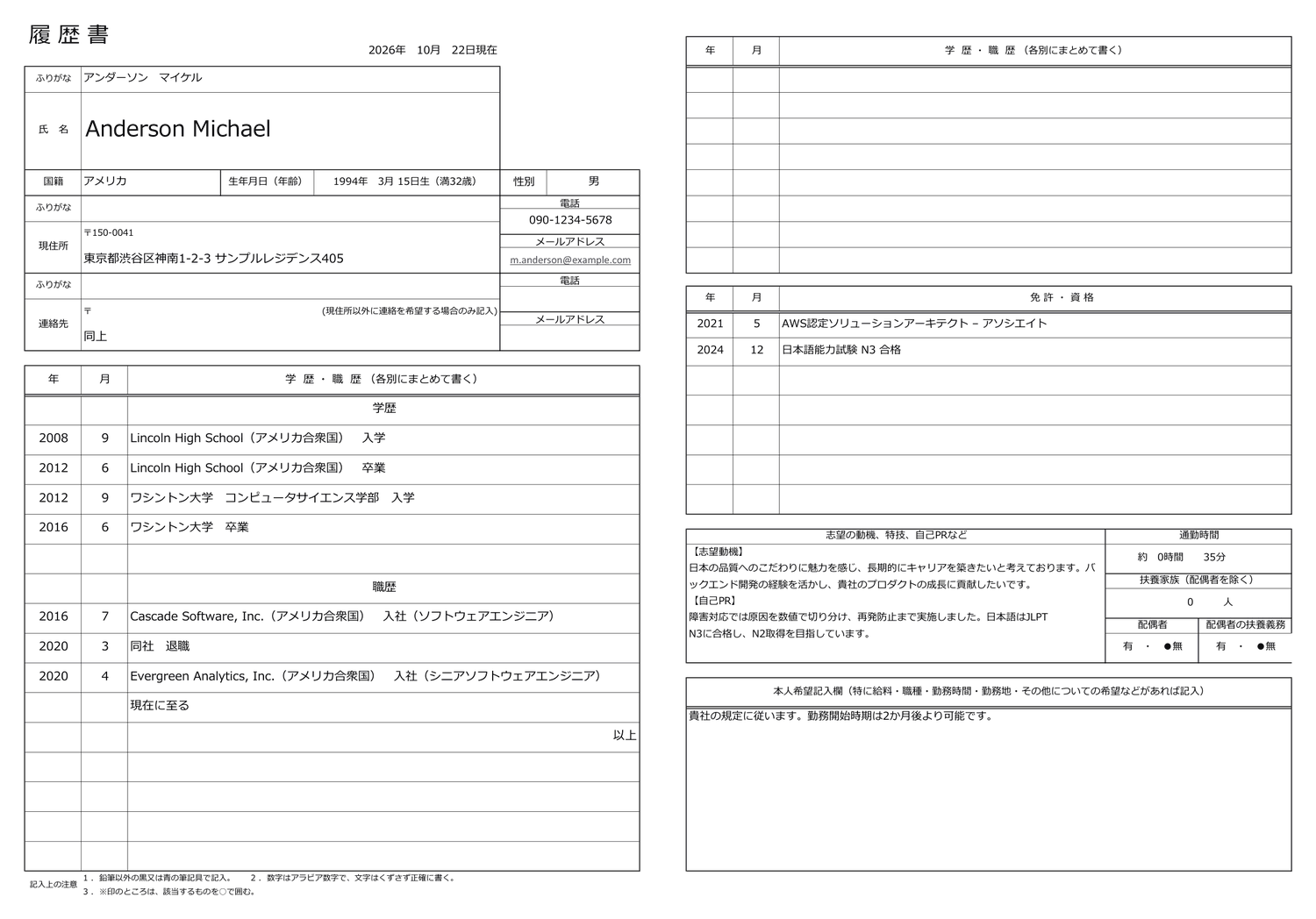
Michael Anderson (アンダーソン マイケル) is a fictional American software engineer born in 1994 and living in Shibuya. He graduated from Lincoln High School and the University of Washington (ワシントン大学, computer science, 2016), then worked at Cascade Software, Inc. and, since April 2020, at Evergreen Analytics, Inc. as a senior software engineer. He holds AWS Solutions Architect Associate (2021) and JLPT N3 (2024). This is the typical mid-career profile: a short education section and a longer work history.
Why this works
- Photo: the photo box is left empty in this sample. A real application needs a recent, plain-background headshot in business clothing, which employers read as a sign that you understand local norms.
- Dates: every school and job has a start and end month, in one consistent format, with no unexplained gaps.
- 学歴・職歴 phrasing: company names are written in full with 入社 (joined) and 退社 (left) lines, and the current employer is shown as still employed.
- 免許・資格: the AWS certification and JLPT N3 are listed with the year obtained, so the employer can see technical and language level at a glance.
- 志望動機 and 自己PR: keep them in polite business Japanese (です・ます) and tie them to the specific company. The details of his projects live in the 職務経歴書 (Example 4).
Example 2: Indonesian new graduate with JLPT N2
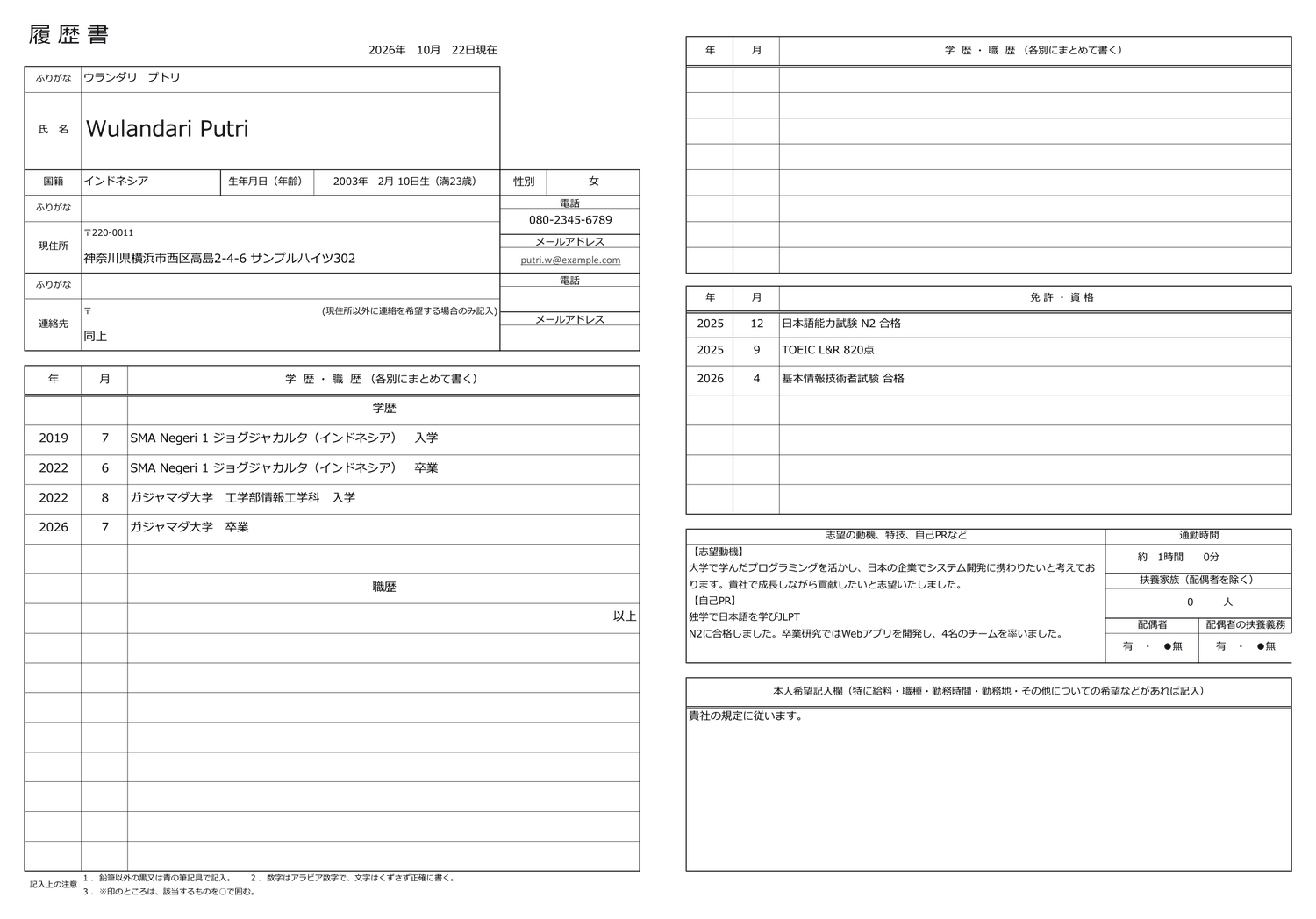
Putri Wulandari (ウランダリ プトリ) is a fictional Indonesian new graduate born in 2003 and living in Yokohama. She finished SMA Negeri 1 Jogjakarta and graduates from the information engineering department of the Faculty of Engineering at Gadjah Mada University (ガジャマダ大学) in July 2026. She has no work history. Her qualifications are JLPT N2 (December 2025), TOEIC 820 and the 基本情報技術者試験 (April 2026).
Why this works
- Education leads: with no work history, the 学歴 section does the work. List the school, faculty, department and graduation month.
- Qualifications: JLPT N2, TOEIC 820 and the 基本情報技術者試験 sit in the 免許・資格 box with the exam month, because language and technical level are the first things an employer checks.
- Photo: the photo box is left empty in this sample. A real application needs a recent headshot in business clothing.
- 志望動機: for a new graduate, explain why this industry and why Japan, using study or project experience instead of job experience.
Want one like these for your own background?
Write in English and get a Japanese 履歴書 and 職務経歴書. The Japanese PDF is free; paid plans unlock editable Excel and Word.
Create my 履歴書 freeExample 3: Vietnamese hospitality worker moving into IT support
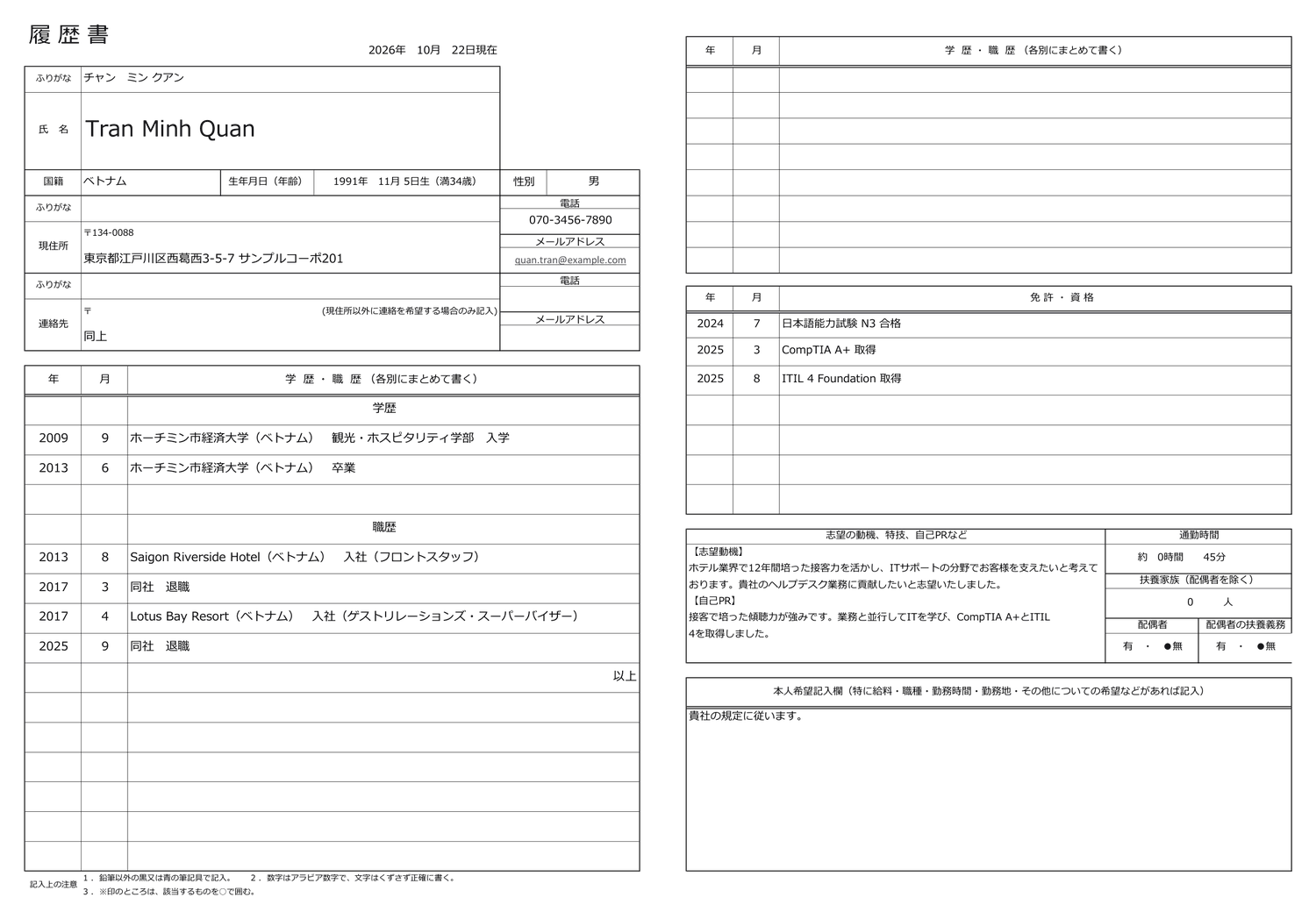
Tran Minh Quan (チャン ミン クアン) is a fictional Vietnamese professional born in 1991 and living in Nishikasai, Edogawa. He graduated from the tourism and hospitality faculty of Ho Chi Minh City University of Economics (ホーチミン市経済大学) in 2013, worked as front desk staff at Saigon Riverside Hotel (2013 to 2017) and as a guest relations supervisor at Lotus Bay Resort (2017 to 2025). He holds JLPT N3, CompTIA A+ and ITIL 4, and his motivation is moving from 12 years of hospitality into IT support. The challenge is explaining a change of field without hiding the past.
Why this works
- Work history stays honest: both hospitality roles are listed normally, including the move up to supervisor.
- Certifications: CompTIA A+ and ITIL 4 go into 免許・資格 next to JLPT N3, showing the move into IT is deliberate.
- 志望動機: states the reason for the change plainly, then links 12 years of customer-facing experience to the new role.
- 本人希望記入欄: 貴社の規定に従います is the standard wording when you have no special requests.
- Photo: the photo box is left empty in this sample. A real application needs a recent headshot in business clothing.
Example 4: Career history (職務経歴書) for the US engineer
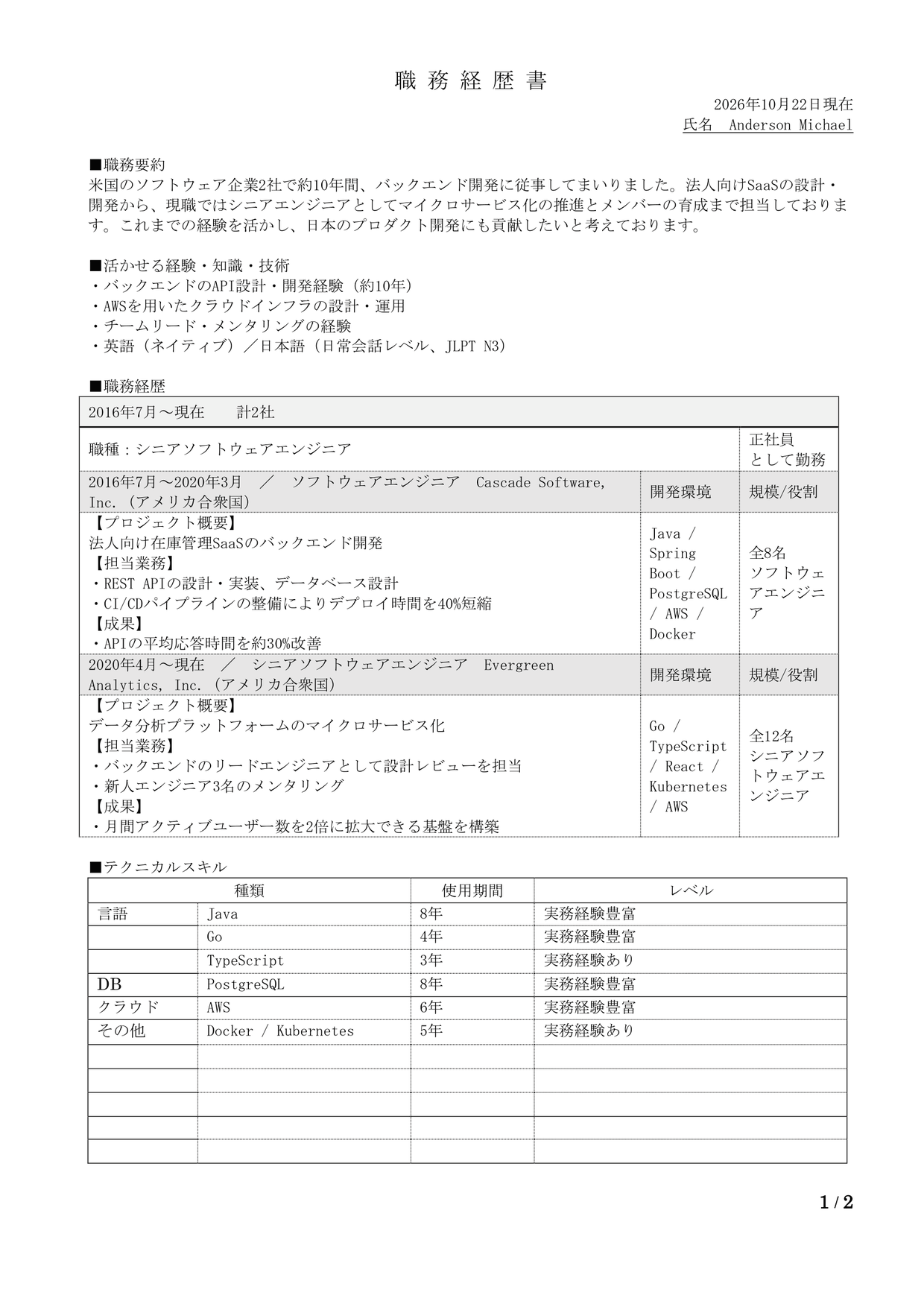
The career history that goes with Example 1, over two pages. The rirekisho lists where Michael worked; this document explains what he did at Cascade Software, Inc. and Evergreen Analytics, Inc.
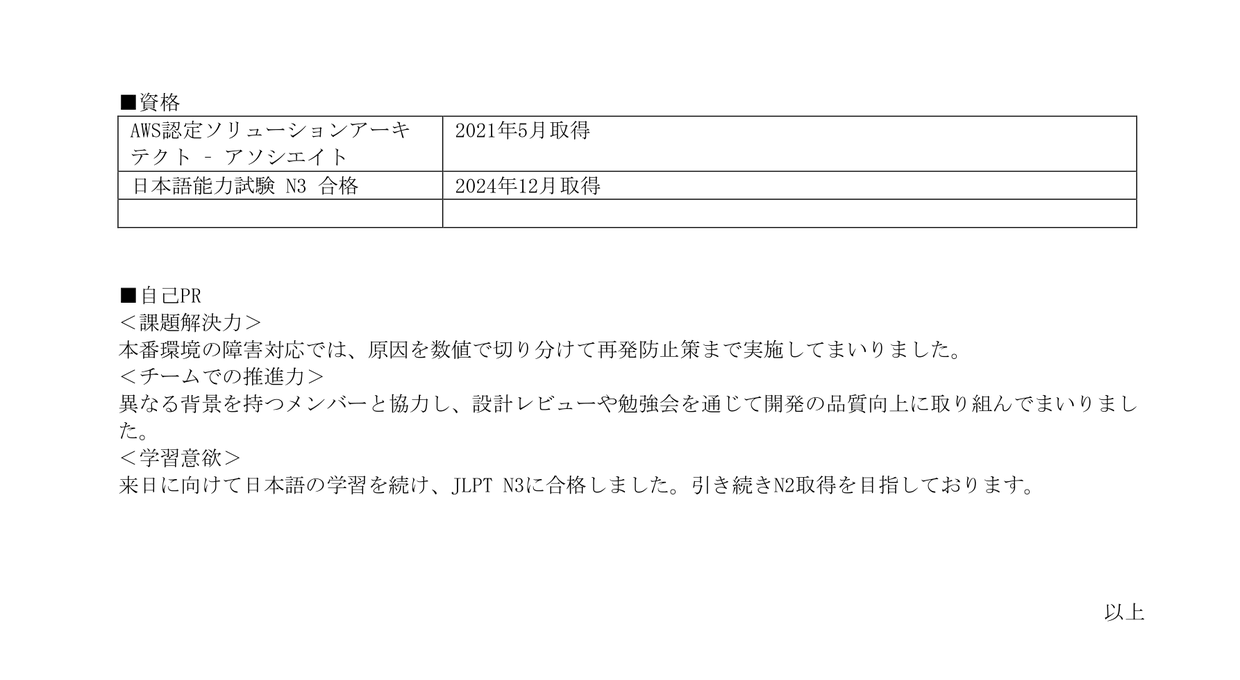
Why this works
- Company by company: period, role and team size for each employer, newest first.
- Per project: an overview, the duties, the results and the tech stack, so the recruiter sees what was built and with what.
- Skills table: six rows of skills in one scannable block.
- Page 2: licenses and qualifications, then a 自己PR written as three paragraphs, each headed by a <…> strength.
For wording help, read how to write 志望動機 and 自己PR, the shokumukeirekisho guide, and how to convert an English resume to Japanese.
Frequently asked questions
Are these real people?
No. All four samples are fictional. They were generated with Rireksho from English input to show what the output looks like.
Can I copy the wording of a sample?
Use them as a guide for structure and tone, not as text to paste. Employers can tell a generic 志望動機 immediately. Write about your own experience and the company you are applying to.
Which sample is closest to my situation?
If you have several years of work, use Example 1 with the career history in Example 4. If you are a recent graduate, use Example 2. If you are changing field, use Example 3.
Do I need to know Japanese to make a resume like these?
No. You enter your information in English, or import an existing resume in any language, and Rireksho produces the Japanese 履歴書 and 職務経歴書. Reading the result before you submit is still a good idea.
Can I edit the result?
The free plan gives you a Japanese PDF. Paid plans unlock editable Excel and Word files with AI-written 志望動機 and 自己PR, so you can adjust them for each company.
Generate your own Japanese resume
Write in English and get a Japanese 履歴書 and 職務経歴書. The Japanese PDF is free; paid plans unlock editable Excel and Word.
Create my 履歴書 free