
Shokumukeirekisho: The Japanese CV Explained (職務経歴書)
Last updated: October 2026
If you are applying for a job in Japan, you will probably be asked for two documents. The first is the rirekisho, a standard form. The second is the 職務経歴書 (shokumu keirekisho, literally "work history document"). Many foreign applicants know the first one and are surprised by the second. This guide explains what the shokumukeirekisho is, how to structure it, and how to write strong sentences, including examples for people who are not engineers.
What is a shokumukeirekisho?
The shokumukeirekisho is the Japanese equivalent of a detailed CV. Where the rirekisho lists facts in fixed boxes (name, address, schools, employers, dates, qualifications), the shokumukeirekisho tells the story behind those facts: what you were responsible for, which projects you worked on, which tools you used and what results you achieved.
Hiring managers in Japan often read the rirekisho to check eligibility and the shokumukeirekisho to decide whether to invite you to an interview. For mid-career hires it is usually the more important of the two. A Western CV or LinkedIn export does not replace it, because Japanese employers expect a specific tone, order and level of detail.
When do you need one?
- Mid-career applications (中途採用, chuto saiyo): almost always required, often submitted together with the rirekisho.
- Recruiter or agent submissions: agencies usually ask for both documents before they forward you to a company.
- New graduates with no full-time experience normally do not need one. They write an entry sheet instead.
- Foreign-owned companies and some startups may accept an English CV, but a Japanese shokumukeirekisho still helps when Japanese colleagues are screening.
Read the job posting carefully. If it says 履歴書・職務経歴書 (rirekisho and shokumukeirekisho), send both.
There is no official format, but there are three common ones
Unlike the rirekisho, the shokumukeirekisho has no mandatory template. Hello Work and major recruiting sites describe three standard ways to organise it:
1. Chronological (編年体式, hennentai-shiki)
Oldest job first, newest last. This is the most common style and suits people with a steady career and few job changes, because it shows growth over time.
2. Reverse-chronological (逆編年体式, gyaku-hennentai-shiki)
Newest job first. Choose it when your current or most recent role is the strongest match for the position. It is the order most English-language CVs already use, so it feels natural if you are converting a Western resume.
3. Career-based (キャリア式, kyaria-shiki)
Experience is grouped by skill, role type or project instead of by employer. It suits specialists, freelancers, and people who changed jobs often and want to show a clear through-line.
If you are unsure, use reverse-chronological. It puts the most relevant information on page one, where the reader will actually look.
Write it in English. Apply in natural Japanese.
Rireksho builds the 履歴書 and 職務経歴書 from your English input or an imported PDF / DOCX resume. Free Japanese PDF, no credit card.
Create my 履歴書 freeThe standard structure
Whatever format you choose, most shokumukeirekisho contain the same five blocks. Keep the whole document to one or two A4 pages. Hello Work advises one to two sheets, and concise writing is part of what is being evaluated.
1. Career summary (職務要約, shokumu yoyaku)
Three to four sentences at the top: how many years you have worked, in which industries and roles, and your main strength. Busy readers often decide here whether to keep reading.
2. Work history (職務経歴, shokumu keireki)
For each employer: company name, dates, business description or size if it helps, your title and department, your responsibilities, and your results. Use short bullet points under each job rather than long paragraphs. Only list roles that are relevant.
3. Experience and skills you can apply (活かせる経験・知識・スキル)
A short list of the strengths you bring to this specific role: tools, languages (include your JLPT level or English level if relevant), domain knowledge and management experience. Tailor it to each posting.
4. Qualifications (資格, shikaku)
Licenses and certificates that relate to the job. These also appear on your rirekisho, so keep names and dates identical in both documents.
5. Self-PR (自己PR, jiko PR)
A closing paragraph that sums up your strengths with one concrete example. For how to write it, see our guide to jiko PR and shiboudouki.
What it looks like
The sample below shows a two-page career history for a fictional US software engineer: page 1 has the companies, page 2 the qualifications and self-PR. Notice the plain layout, the dated headings and the short, result-oriented lines.
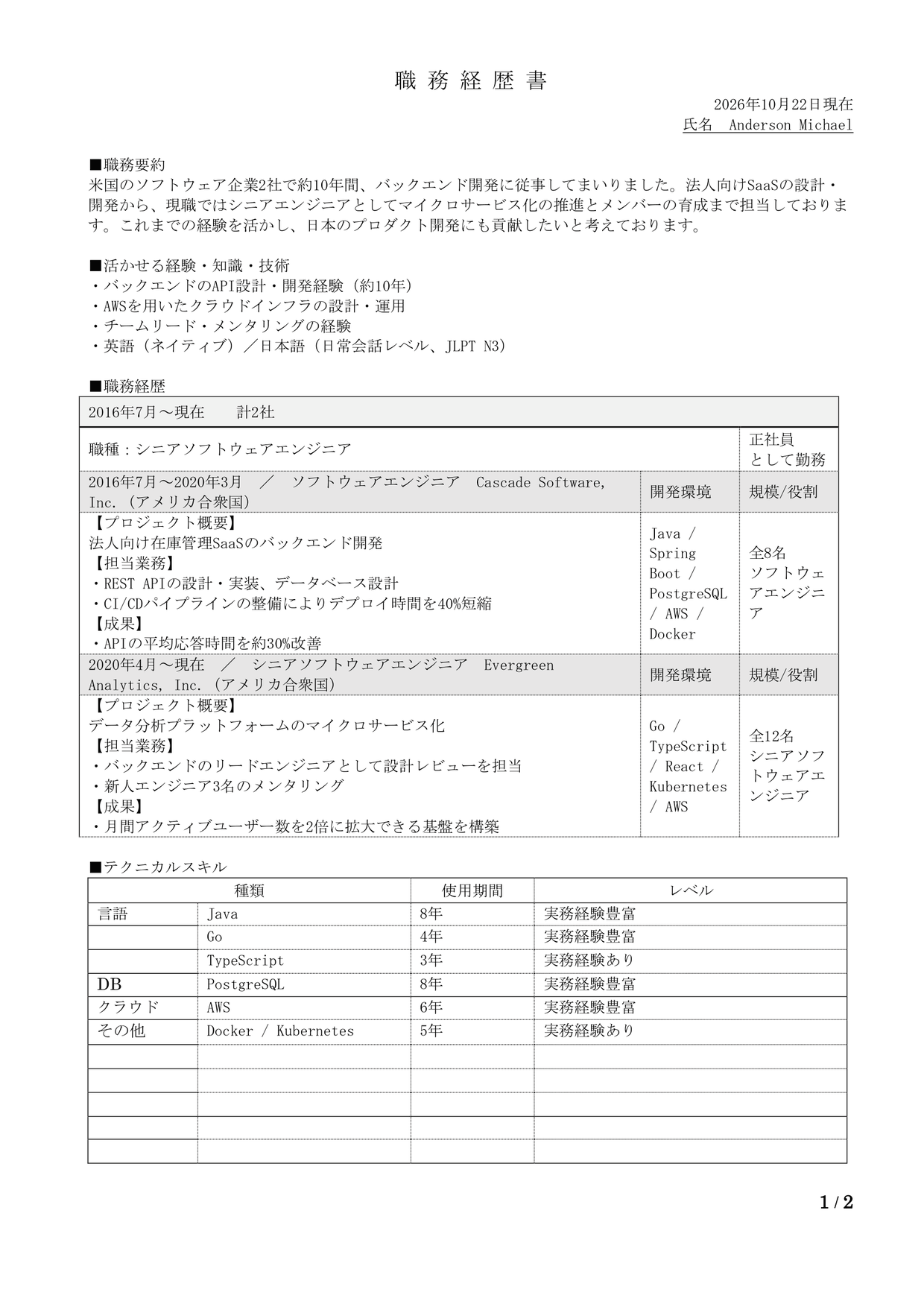
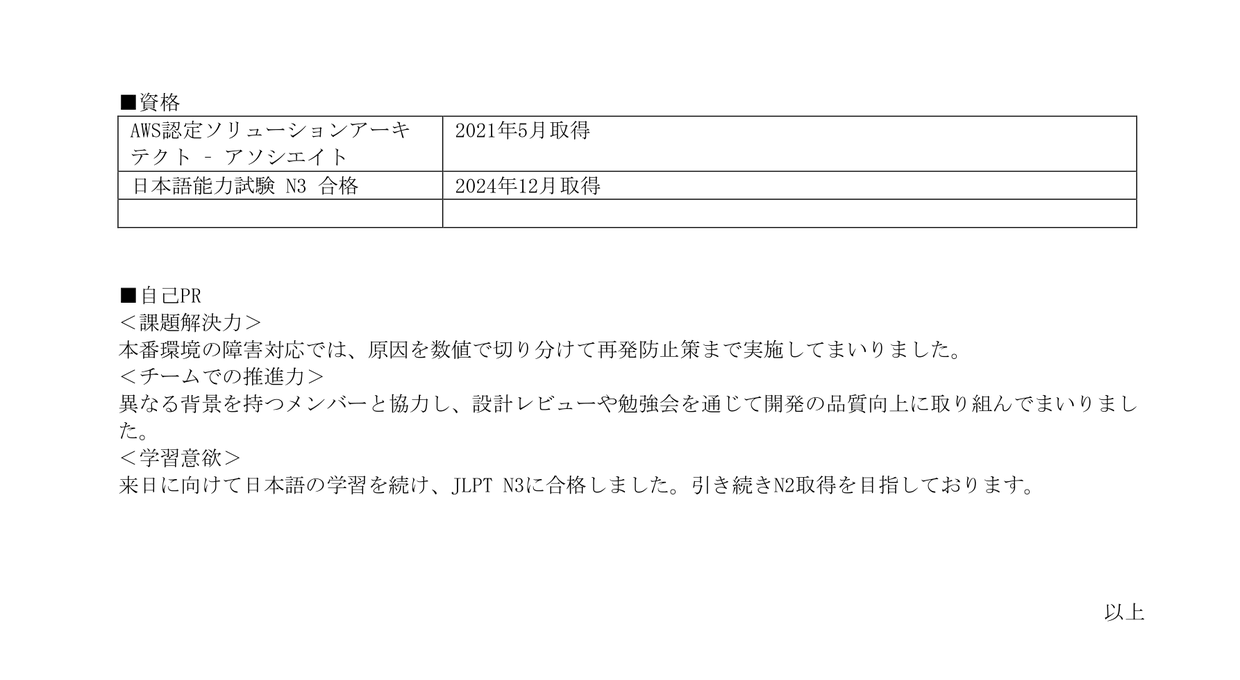
You can compare it with the rirekisho example and see the template guide for the rirekisho format. Rireksho generates a filled-in 職務経歴書 from your own input.
Write achievements with numbers
The biggest difference between a weak and a strong shokumukeirekisho is the same as in any CV: results, not duties. The Japanese pattern is simple: what you were in charge of (担当), what you did, and the measurable outcome (成果). Use the polite past form (〜しました) or a noun-ending bullet style (〜を担当) and stay consistent.
Engineer
English
I managed backend development and improved API response time by 40%.
Japanese
バックエンド開発を担当し、APIの応答速度を40%改善しました。
English
Led a team of five engineers to migrate a monolith to microservices, cutting deployment time from two hours to 15 minutes.
Japanese
5名のエンジニアチームを率いてモノリスからマイクロサービスへの移行を主導し、デプロイ時間を2時間から15分に短縮しました。
Sales
English
Managed 30 corporate accounts and exceeded the annual sales target by 120% for three consecutive years.
Japanese
法人顧客30社を担当し、3年連続で年間売上目標を120%達成しました。
English
Built a new outreach process that increased qualified leads by 35%.
Japanese
新規開拓の手法を見直し、有効リード数を35%増加させました。
Hospitality
English
As front desk supervisor at a 200-room hotel, I trained 12 staff members and raised our guest satisfaction score from 4.1 to 4.6.
Japanese
客室数200室のホテルでフロント主任として、スタッフ12名の教育を担当し、宿泊客満足度を4.1から4.6に向上させました。
English
Handled English, Chinese and Japanese inquiries and reduced complaints by 25%.
Japanese
英語・中国語・日本語での問い合わせ対応を担当し、クレーム件数を25%削減しました。
Teaching
English
Taught English to 120 junior high school students per week and designed a speaking program that raised average test scores by 15%.
Japanese
中学生を対象に週120名の英語指導を担当し、スピーキング中心の独自カリキュラムを設計して、平均点を15%向上させました。
English
Coordinated lessons with five Japanese co-teachers.
Japanese
日本人教員5名と連携し、授業計画の立案・運営を行いました。
If you do not have a number, describe scope instead: team size, customer count, budget, frequency or region. Never invent figures. Interviewers will ask about them.
Common mistakes
- Pasting a translated Western CV. Literal translation produces the wrong register. Rewrite it in the Japanese structure above, or see how to convert an English resume into Japanese.
- Listing duties, not results. "Responsible for sales" tells the reader nothing. Add scale and outcome.
- Too long. Three or more pages for a short career signals poor prioritisation. Cut old or irrelevant roles.
- Inconsistent dates and names. Employer names, titles and dates must match the rirekisho exactly. Mismatches are an easy reason to reject.
- Mixed styles. Switching between です・ます and plain form, or between several fonts, looks careless. Pick one of each.
- One document for every company. Rewrite the summary and skills block for each role.
- Decoration. Japanese employers generally expect black text on white, one clean Gothic or Mincho font, and no photos or colors in this document.
How Rireksho can help
Rireksho is built for exactly this workflow. You type your history in English, or upload an existing PDF or DOCX resume (up to 10MB) and the form is pre-filled. The AI writes Japanese business phrasing, and you review and edit every line before downloading. The Japanese PDF is free; the paid options add editable Excel and Word files plus AI-written 志望動機 and 自己PR. No other English-language tool produces both documents from an English resume.
Write it in English. Apply in natural Japanese.
Rireksho builds the 履歴書 and 職務経歴書 from your English input or an imported PDF / DOCX resume. Free Japanese PDF, no credit card.
Create my 履歴書 freeFrequently asked questions
Is a shokumukeirekisho the same as a rirekisho?
No. The rirekisho (履歴書) is a standardized form with basic facts: profile, education, work history dates and qualifications. The shokumukeirekisho (職務経歴書) is a free-format document that explains what you did in each job and what results you produced. Most mid-career applications ask for both.
How long should a shokumukeirekisho be?
Aim for one to two A4 pages. Hello Work (the Japanese public employment service) advises keeping it to one or two sheets, and being able to summarise concisely is itself read as a skill. Senior candidates with many roles sometimes go to three pages, but two is the safe target.
Which format should I choose: chronological, reverse-chronological or career-based?
Chronological (編年体) suits a steady career with few job changes. Reverse-chronological (逆編年体) puts your latest and strongest role first. Career-based (キャリア式) groups experience by skill or project and suits specialists or people with many short roles. There is no single correct format.
Can I write it in English?
Only if the employer asks for English, for example at a foreign-owned company. For most Japanese companies, write it in Japanese. If you do not write Japanese yourself, draft it in English and have it converted into natural business Japanese.
Do I include part-time jobs?
Usually only full-time and contract roles that relate to the job. Student part-time jobs are generally left out, unless they are directly relevant and you have little other experience.
Does Rireksho make the shokumukeirekisho too?
Yes. You enter your work history in English, or import an existing resume in PDF or DOCX, and Rireksho produces a Japanese 履歴書 and 職務経歴書 that stay consistent with each other. The Japanese PDF is free. Editable Excel and Word files and AI-written 志望動機 and 自己PR are part of the paid options.
Related guides: Japanese resume basics, jiko PR and shiboudouki, English resume to Japanese.