
Guide for international students
How to Find a Job in Japan as an International Student (2026 Guide)
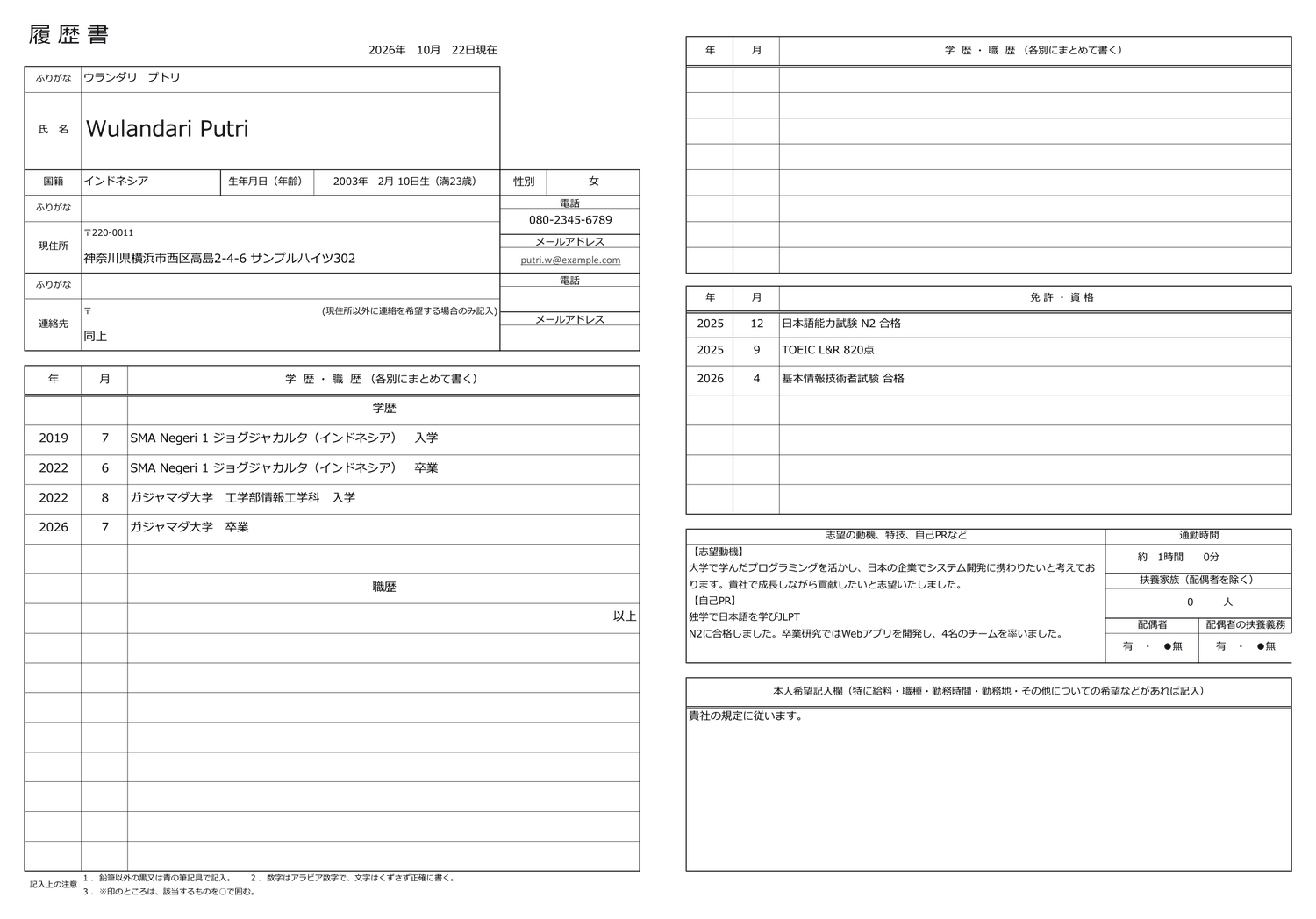
Japanese new-graduate job hunting, called 就活 (shukatsu), is its own system, and many international students do not know where to start. Companies screen strictly on the 履歴書 (rirekisho), and many applicants are rejected at document screening, so yours must be clean and correct.
Last updated: November 2026
Your shukatsu roadmap
For students graduating next April, the usual flow looks like this:
- 1
When: Start of 3rd year
Decide your direction
- Pick an industry or job type (e.g. IT) instead of applying everywhere.
- Check your JLPT level and what companies ask for.
- 2
When: Summer and winter of 3rd year
Internships
- Apply through Mynavi/Rikunabi, company sites and your university.
- Internships are often the fastest route to an offer.
- 3
When: From March of 3rd year (IT/foreign companies earlier)
Company info sessions (説明会)
- Join on-campus and online events.
- Ask questions.
- Note the companies you like.
- 4
When: 3rd year spring
Rirekisho and entry sheet (ES)
- Prepare a perfect 履歴書.
- Write 自己PR, ガクチカ and 志望動機.
- Ask your career center to check them.
- 5
When: After applying
Aptitude test
- Often an online test such as SPI.
- Practice beforehand.
- 6
When: Usually several rounds
Interviews
- See the interview flow below.
- 7
When: Traditionally from October 1 of 4th year; IT often earlier
内定 (job offer) and visa
- Accept the offer, then change your visa.
- See the visa section below.
What the selection process looks like
- 1Online application (履歴書 + ES)
- 2Aptitude test (SPI)
- 31st interview
- 42nd interview
- 5Final interview
- 6内定 (offer)
1st interview
Usually HR. Basics, why Japan, and your Japanese ability.
2nd interview
Team members or managers. For IT jobs they often ask about your projects, so prepare one project to explain.
Final interview
Executives. Your motivation and fit with the company.
The exact steps differ by company.
Where to find jobs
English job boards
Best for: IT jobs: solve coding problems, get a skill rank, and companies send you offers (paiza新卒 for students)
JapaneseRecruitment agencies (free for job seekers)
Agencies mostly place people with some work experience, but they are free for job seekers and worth registering with once you graduate or if you have internship experience.
New-graduate sites and events
マイナビ / リクナビ
Best for: Most Japanese companies hiring new graduates; both have pages for international students
JapaneseBest for: Bilingual job fairs and new-grad hiring (e.g. Tokyo Career Forum)
English / JapaneseBig joint job fairs (合同説明会)
Best for: Meet many companies in one day at large venues such as Tokyo Big Sight (東京ビッグサイト)
JapaneseUniversity career center and events
Best for: 履歴書 and ES checks, advice, on-campus company sessions and career fairs
Japanese (some English)Hello Work Employment Service Center for Foreigners (外国人雇用サービスセンター)
Best for: Free government job support for international students and graduates
Japanese / EnglishMost Japanese new-grad sites, マイナビ (Mynavi) and リクナビ (Rikunabi), have pages for international students. Your career center (キャリアセンター) can check your 履歴書 and ES, and also run on-campus and online company events (学内説明会) and career fairs, including ones for international students. Internships: often the fastest route to an offer.
What to prepare
- 履歴書: create it with the Rireksho builder. You can download just the 履歴書.
- Entry sheet answers: 自己PR, ガクチカ (学生時代に力を入れたこと) and 志望動機. See how to write 志望動機 and 自己PR.
- Aptitude test practice: practice tests such as SPI before you apply.
- For IT roles: a project you can explain clearly in the interview.
Before you apply, check:
- Photo is recent with a plain background
- Dates use the same format everywhere (Japanese era or Western)
- Education history is complete and in order
- No blank sections
- JLPT level and other qualifications are listed with dates
- 志望動機 is specific to the company
Get your rirekisho right the first time
Write in English and get a Japanese 履歴書 and 職務経歴書. The Japanese PDF is free; paid plans unlock editable Excel and Word.
Create my 履歴書 freeVisa after the offer
This is general information, not legal advice. After you get an offer, you change your status of residence from Student (留学) to a work visa such as Engineer/Specialist in Humanities/International Services (技術・人文知識・国際業務) at the immigration bureau. If you are still job hunting after graduation, the Designated Activities (特定活動) job-hunting status may be available with a university recommendation.
Confirm the details with your university and the Immigration Services Agency.
How I did it
From the founder of Rireksho
When I was a university student in Japan, I didn't know where to look for internships or jobs. What I learned quickly: Japanese companies are strict about the 履歴書, and many applicants are rejected just from it, so it has to be perfect.
I went to the career fair at my university, where a career advisor helped me fix my 履歴書. I joined company events held at my university, many of them online. I also went to a big job fair at Tokyo Big Sight, where I could talk to many companies in one day. I started applying early, in my 3rd year. Instead of applying everywhere, I focused only on IT companies, which made it easier to prepare.
The process had many steps: an online aptitude test, then three interviews. In the second interview they asked about my projects, so for IT jobs prepare one project you can explain well. After the final interview, I got my offer (内定).
I built Rireksho so other international students can get their 履歴書 right without needing that same luck.
Frequently asked questions
When should international students start job hunting in Japan?+−
If you graduate next April, start in your 3rd year: summer and winter internships, then company info sessions from March. IT companies, startups and foreign-affiliated companies often hire earlier, so do not wait until your 4th year.
Where can foreigners find jobs in Japan in English?+−
English-friendly boards include TokyoDev, Japan Dev, LinkedIn, GaijinPot Jobs, Daijob, CareerCross and Wantedly. Recruitment agencies such as Michael Page and Robert Walters are free for job seekers. Your university career center and its company events are also a good source.
Do I need a shokumukeirekisho as a new graduate?+−
Usually no. New-graduate applications normally need a 履歴書 (rirekisho) and entry sheet (ES) answers. The 職務経歴書 (shokumukeirekisho) is mainly for people with work experience.
Why is the rirekisho so important in Japanese job hunting?+−
Companies screen documents strictly, and many applicants are rejected at document screening. A clean, correct 履歴書 helps you reach the interview stage.
Ready to apply in Japan?
Write in English and get a Japanese 履歴書 and 職務経歴書. The Japanese PDF is free; paid plans unlock editable Excel and Word.
Create my 履歴書 free